It's Monday morning. Before you've finished your coffee, a software "colleague" has read your inbox, rescheduled a clashing meeting, chased a late invoice and opened a pull request that fixes the bug your customer reported over the weekend. Nobody typed a prompt for each step. You gave it a goal, and it worked out the rest.
That is agentic AI: AI that doesn't just answer questions but plans, takes actions with real tools and checks its own work until a goal is met. After two years of chatbots, it's the shift every major tech company is betting on, and the numbers show why. Gartner expects 40% of enterprise apps to include task-specific AI agents by the end of 2026, up from under 5% in 2025.
In this guide you'll learn what agentic AI is, how autonomous AI agents work under the hood, which frameworks developers use, where companies are getting real results, what can go wrong, and what to expect in 2027.
Agentic AI is a type of artificial intelligence that can pursue a goal on its own. It breaks the goal into steps, decides which tools to use, takes actions, looks at the results and adjusts its plan, with only as much human input as you choose to give it.
The word "agentic" comes from agency: the ability to act independently. A regular AI model responds. An agent acts.
A simple analogy: think of a GPS versus a taxi driver. A GPS (generative AI) gives you directions when you ask. A taxi driver (agentic AI) takes your destination, picks the route, reacts to a closed road, refuels if needed and gets you there. You set the goal; the agent handles the journey.
Under the hood, most of today's AI agents are built on a large language model (LLM) such as GPT, Claude or Gemini. The LLM acts as the "brain", and it's wrapped in software that gives it memory, tools and a loop that lets it keep working until the task is done.
These three terms get mixed up constantly. Here's how they compare side by side.
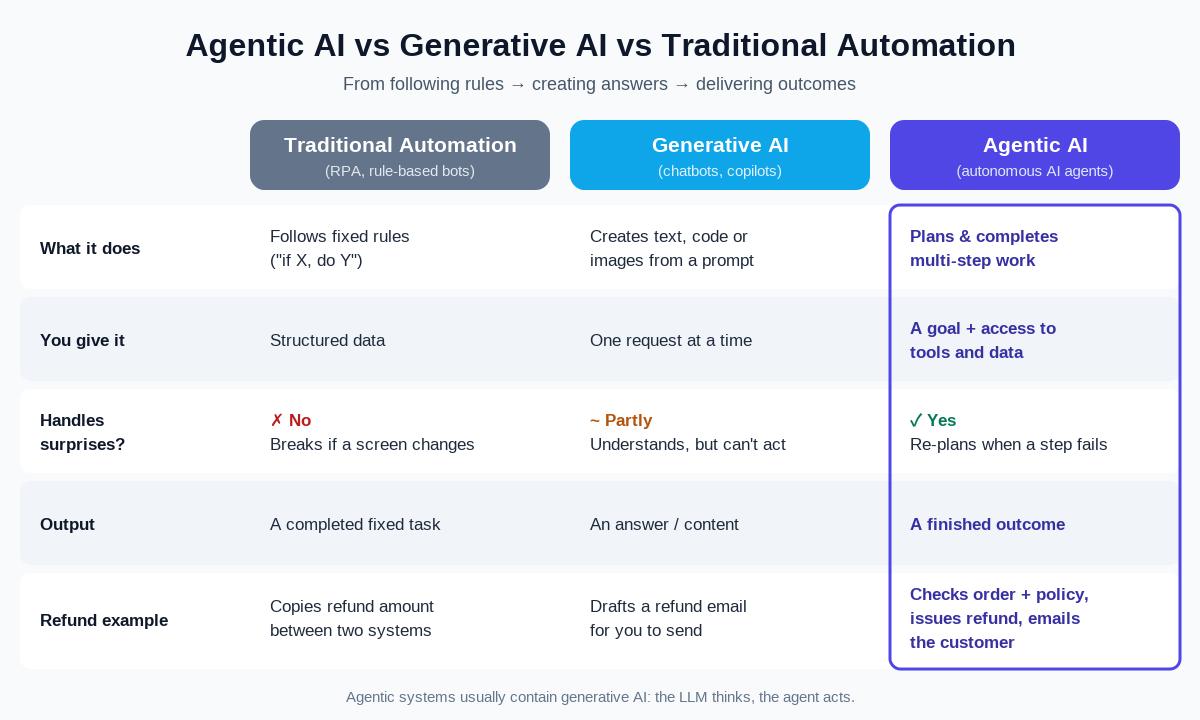
Agentic AI vs generative AI vs traditional automation at a glance.
What it does: follows fixed, pre-written rules ("if X, do Y").
Input: structured data in a predictable format.
Handles surprises? No. It breaks when a screen or form changes.
Best for: stable, repetitive back-office tasks.
Example: a bot that copies invoice totals from one system into another.
What it does: creates content (text, code, images) in response to a prompt.
Input: natural language, one request at a time.
Handles surprises? Partly. It understands messy language but doesn't act on the world.
Best for: drafting, summarizing, brainstorming, answering questions.
Example: asking a chatbot to write a refund email.
What it does: plans and carries out multi-step work toward a goal.
Input: a goal, plus access to tools and data.
Handles surprises? Yes. It can re-plan when a step fails.
Best for: workflows that need judgment across several systems.
Example: an agent that checks the order, confirms the refund policy, issues the refund and emails the customer.
The short version of agentic AI vs generative AI: generative AI produces an answer; agentic AI produces an outcome. In practice, agentic systems usually contain generative AI. The LLM does the thinking, and the agent framework turns that thinking into actions.
Every AI agent, from a customer-support bot to a coding assistant, runs some version of the same cycle. Researchers often call it the agent loop.
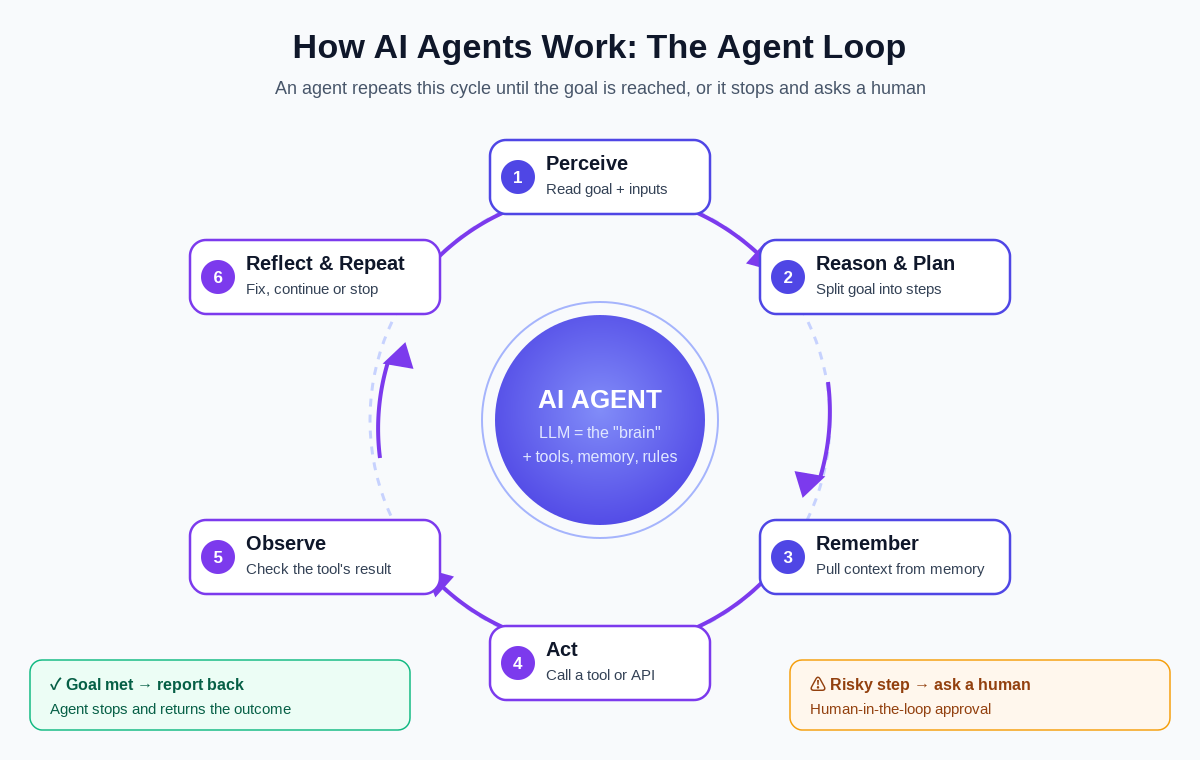
The agent loop: an AI agent repeats these six steps until the goal is met or a human needs to approve.
Perceive. The agent takes in its goal and the current situation: a user request, an email, a support ticket, a database record or a webpage.
Reason and plan. The LLM breaks the goal into smaller steps and decides what to do first. ("To process this refund I need the order ID, then the policy, then the payment system.")
Remember. It pulls in relevant context from memory: earlier steps in this task, past conversations, or company documents.
Act. It calls a tool: searches the web, queries a database, runs code, sends an API request or fills in a form.
Observe. It reads the result of that action. Did the search return anything useful? Did the payment API return an error?
Reflect and repeat. It checks progress against the goal, fixes mistakes and either takes the next step or stops and reports back.
This "think, act, observe" pattern was popularized by the 2022 research paper ReAct: Synergizing Reasoning and Acting in Language Models, from Princeton and Google researchers. They showed that letting a model alternate between reasoning steps and tool use made it more accurate and easier to follow than reasoning alone.
Analogy: it's how a good intern tackles an unfamiliar task. Make a plan, try something, look at what happened, adjust, and ask the manager when stuck.
An AI agent isn't one piece of software. It's a stack of building blocks working together.
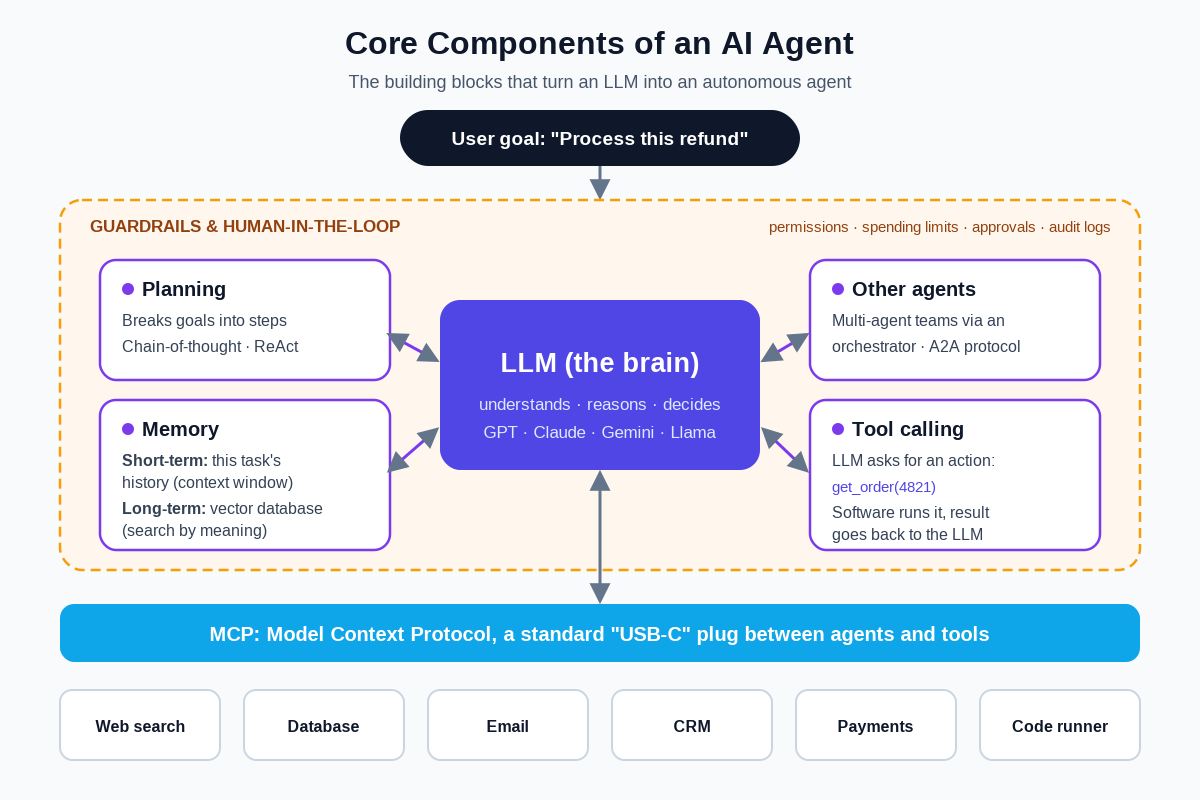
How the core components of an AI agent fit together.
The large language model handles understanding, reasoning and decision-making. Stronger models plan better, make fewer tool-use mistakes and recover more gracefully from errors.
Techniques like chain-of-thought (thinking step by step) and ReAct (interleaving reasoning with actions) help the model break big goals into small, checkable steps. Some systems also use a separate "planner" that writes a task list before any work begins.
Short-term memory is the conversation and task history held in the model's context window: what it has already tried in this session.
Long-term memory persists across sessions. It's often stored in a vector database, which saves information as numerical "embeddings" so the agent can find related facts by meaning, not exact keywords.
Tool use (or function calling) is what turns a chatbot into an agent. The model outputs a structured request ("call get_order_status with order 4821"), the software runs it, and the result goes back to the model. Tools can be anything with an API: search, email, CRMs, payment systems, code interpreters, even a web browser.
5. Model Context Protocol (MCP)
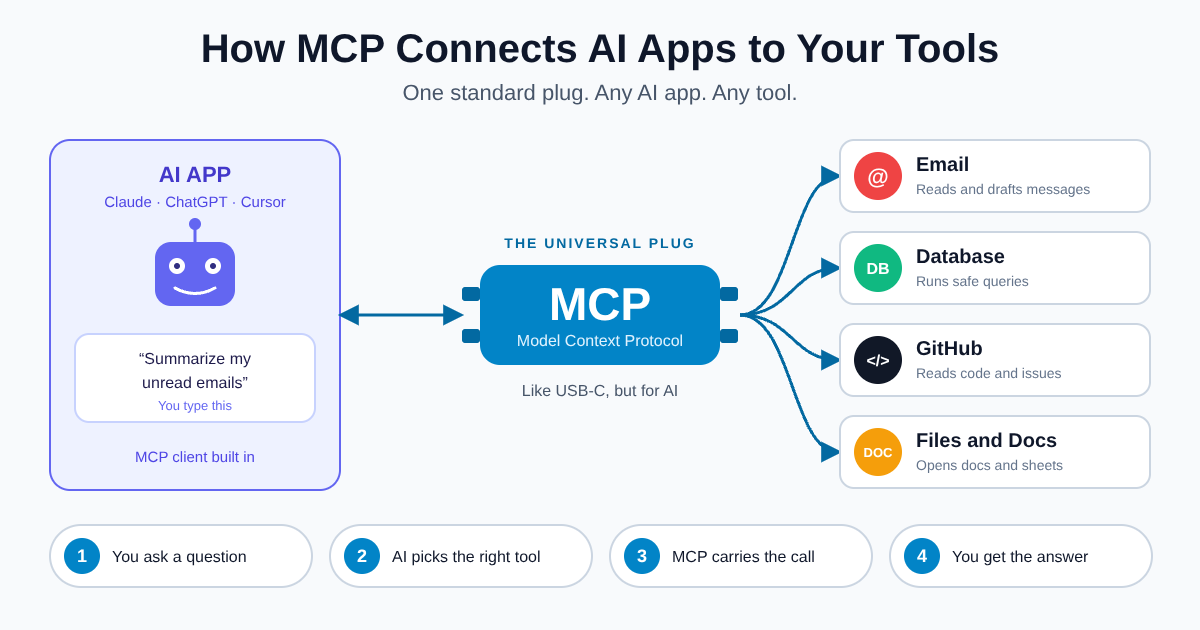
Connecting every model to every tool used to mean custom code for each pair. The Model Context Protocol (MCP), introduced by Anthropic in late 2024, standardizes this, a bit like USB-C for AI tools. In December 2025, Anthropic donated MCP to the new Agentic AI Foundation (AAIF) under the Linux Foundation, alongside OpenAI's AGENTS.md and Block's goose. At launch, the foundation reported more than 10,000 published MCP servers.
For complex work, one generalist agent is often replaced by a team of specialists: a researcher, a writer, a fact-checker and a supervisor that hands out tasks. An orchestrator manages who does what and in which order. For agents talking across companies and platforms, Google's Agent2Agent (A2A) protocol, donated to the Linux Foundation in June 2025, gives them a shared language.
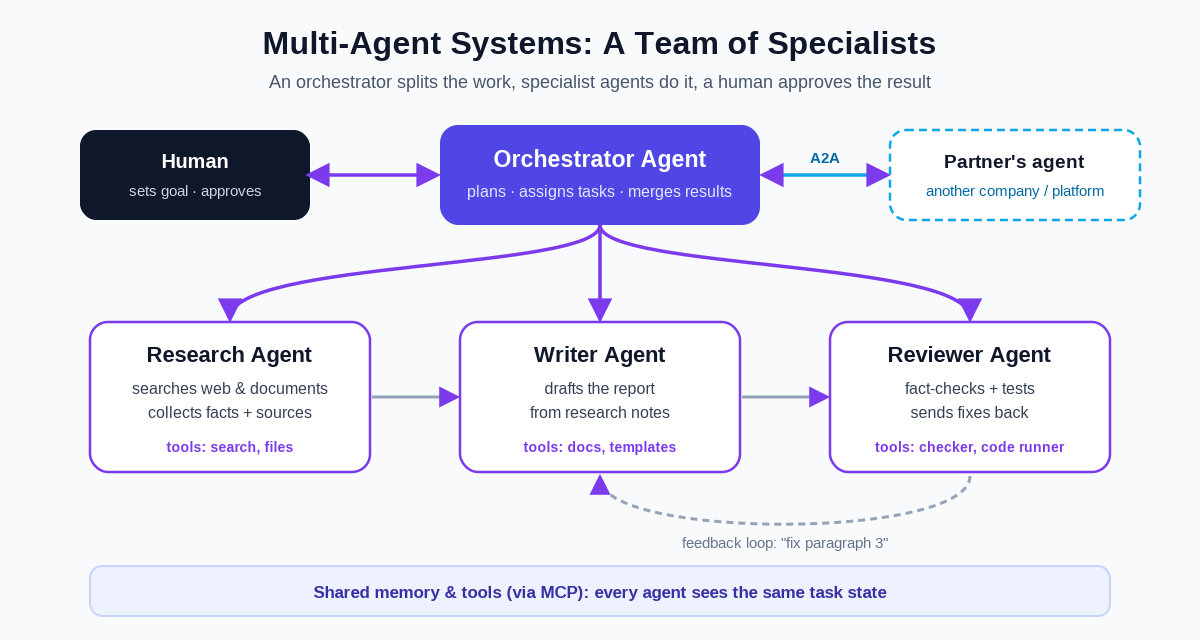
A multi-agent system: an orchestrator coordinates specialist agents, with a human in the loop.
Production agents need limits: which tools they may call, spending caps, and approval steps before risky actions like sending money or deleting data. This human-in-the-loop layer is what makes autonomy safe enough to deploy.
Classic AI textbooks group agents by how they decide what to do. These categories still help explain modern systems.
Simple reactive (reflex) agents: respond to the current input with fixed rules and no memory. Example: a thermostat, or a spam filter that blocks known bad senders.
Model-based agents: keep an internal picture of the world, so they can act sensibly when they can't see everything. Example: a robot vacuum that remembers which rooms it has cleaned.
Goal-based agents: choose actions that move them toward a defined goal. Example: a travel agent that books flights and hotels to fit your dates.
Utility-based agents: weigh trade-offs to pick the best option, not just any option that works. Example: a pricing agent balancing profit margin against sales volume.
Learning agents: improve from feedback over time. Example: a security agent that gets better at spotting phishing as analysts correct it.
Multi-agent systems: several agents with different roles cooperate (or negotiate) to reach a shared goal. Example: a research team of planner, searcher and writer agents.
Most LLM-powered agents today are goal-based, with learning and multi-agent features layered on top.
You don't build an agent from scratch. These frameworks handle the loop, memory, tool calling and orchestration for you. Here's the current landscape, verified as of late 2026.
LangGraph (LangChain): open source. Models agent workflows as graphs with state, branches and checkpoints. Best for: developers who want fine-grained control over complex, long-running workflows.
CrewAI: open source. Builds "crews" of role-based agents (researcher, analyst, writer) that collaborate. Best for: quick multi-agent prototypes with an easy mental model.
Microsoft Agent Framework: open source, .NET and Python. The successor to AutoGen and Semantic Kernel, reaching version 1.0 in April 2026. AutoGen itself is now in maintenance mode. Best for: enterprise teams on Azure and .NET.
OpenAI Agents SDK: open source, launched March 2025. A lightweight runtime built around agents, tools, handoffs, guardrails and tracing. Best for: getting a working agent running in a few lines of Python.
Claude Agent SDK (Anthropic): Python and TypeScript. Renamed from the Claude Code SDK in September 2025, it gives agents the same harness that powers Claude Code: file access, shell commands, sub-agents and MCP. Best for: coding agents and agents that work on a real computer.
Google Agent Development Kit (ADK): open source, introduced at Google Cloud Next 2025. Supports deterministic workflow agents alongside LLM agents, with built-in evaluation and deployment. Best for: multi-agent apps on Google Cloud.
Tip: if you're just starting out, pick the SDK from the model provider you already use, then move to LangGraph or Microsoft Agent Framework when you need heavier orchestration.
Here's where autonomous AI agents are already working in production, with results the companies themselves have reported.
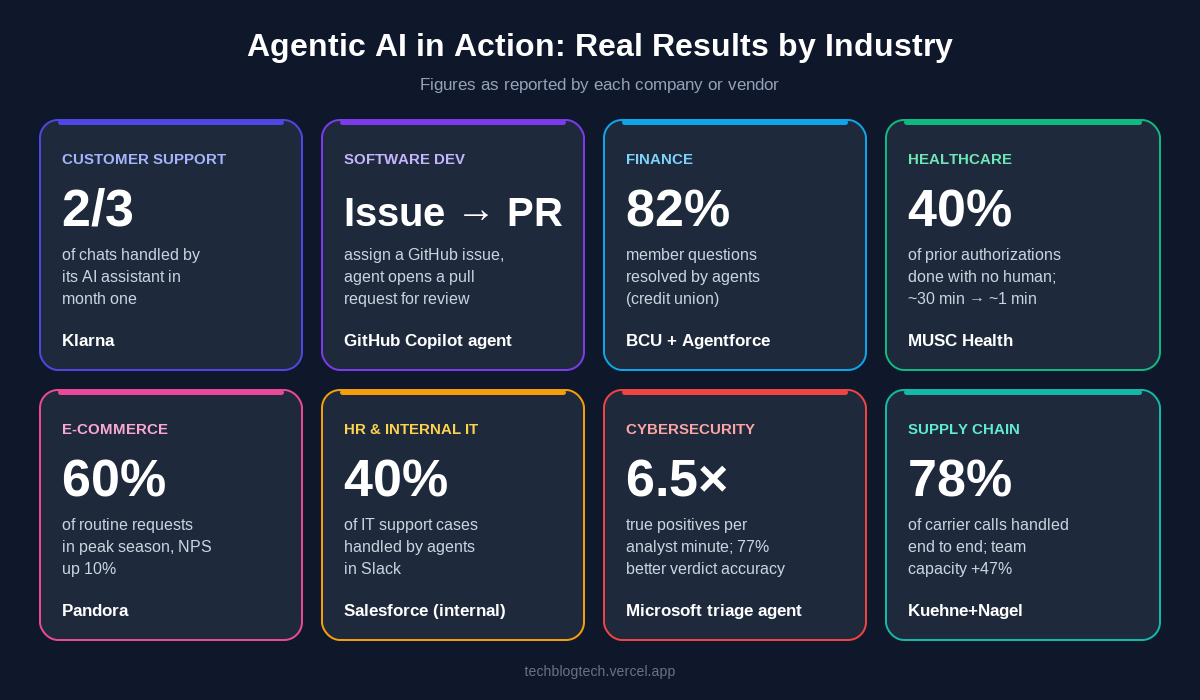
Real agentic AI results reported by companies across eight industries.
Support was the first big win for agents. One month after launch, Klarna's AI assistant had handled 2.3 million conversations, two-thirds of all its customer-service chats, which the company said was equivalent to the work of 700 full-time agents. Customers can still choose a human.
Salesforce runs its own Agentforce agents on its help site and support line. By May 2026, they had autonomously handled about 4 million customer inquiries in 15 months, and Salesforce reports around $100 million in annualized support cost savings.
Coding is where agents have scaled fastest. GitHub's Copilot coding agent became generally available in September 2025: you assign it a GitHub issue, it works in the background and opens a pull request for your review. McKinsey's 2026 survey found about two in ten organizations are already scaling software coding agents, rising to 31% at large enterprises.
BCU, a US credit union with over 360,000 members, uses Agentforce for member service. It reports an 82% resolution rate and 27% faster handling of escalated cases. Banks also use agents for fraud review, reconciliation and know-your-customer (KYC) checks.
Prior authorization, getting insurer approval before a treatment, is notoriously slow. At MUSC Health in South Carolina, agents from Notable now complete about 40% of prior authorizations without human involvement, cutting roughly 30 minutes of manual work to about one minute. Denials still go to a human.
Jewelry brand Pandora's agent, Gemma, handles 60% of routine support requests during peak seasons and has lifted its Net Promoter Score by 10%. Agents are also starting to buy: since September 2025, ChatGPT's Instant Checkout lets shoppers complete purchases in the chat through the open Agentic Commerce Protocol built by OpenAI and Stripe.
Marketing teams use agents to research prospects, personalize outreach, run A/B tests and report on campaigns. McKinsey found insurance leads in the use of AI agents for marketing and sales.
Salesforce uses agents in Slack to answer IT and HR questions for 76,000 employees. They handle 40% of IT support cases and resolved 9,500 cases autonomously in the first two months.
Security teams are drowning in alerts. Microsoft's Phishing Triage Agent sorts user-reported phishing emails on its own. Microsoft says agent-assisted analysts found 6.5 times as many true positives per analyst minute and improved verdict accuracy by 77% versus a control group.
Kuehne+Nagel put AI agents on the repetitive job of chasing carriers for shipment updates. In the first deployment, the agents completed over 10,000 status checks and handled 78% of connected calls end to end, raising the team's capacity by 47%.
Productivity at scale. Agents take over high-volume, repetitive work so people can focus on judgment calls. In McKinsey's 2026 survey, 80% of respondents said AI has improved their individual productivity.
Lower costs. Salesforce's ~$100M in annualized support savings and MUSC's minutes-instead-of-half-hours on prior authorizations show what's possible when agents handle the routine path.
24/7 operation. Agents don't sleep, take holidays or need shift handovers, so customers get answers at 3 a.m. in their own language.
Elastic scalability. Unlike hiring, agent capacity can scale up for Black Friday or tax season and back down afterward.
Faster cycle times. Work that waited in queues, like triage, approvals and status checks, moves in minutes.
Consistency and auditability. Well-designed agents follow the same policy every time and log every step, which makes reviews easier.
Market momentum: MarketsandMarkets projects the AI agents market will grow from $7.84 billion in 2025 to $52.62 billion by 2030, a compound annual growth rate of 46.3%.
Agentic AI is powerful, and power cuts both ways. An agent that can act can also act wrongly.
When a chatbot hallucinates, you get a wrong answer. When an agent hallucinates, it might email the wrong customer, refund the wrong amount or delete the wrong file. Errors can also compound: one bad step early in a long task can derail everything after it.
Agents read untrusted content: emails, webpages and documents. Attackers can hide instructions in that content to hijack the agent. In December 2025, OWASP published its first Top 10 for Agentic Applications. Agent goal hijacking, tool misuse and identity or privilege abuse sit at the top of the list.
Agents make many model calls per task, and costs add up. Gartner predicts over 40% of agentic AI projects will be canceled by the end of 2027 because of escalating costs, unclear business value or weak risk controls. It also warns about "agent washing", vendors rebranding old chatbots and RPA as agents, and estimates only about 130 of the thousands of agentic AI vendors are real.
If an agent makes a bad decision, who is responsible: the vendor, the developer or the business that deployed it? Companies need clear ownership, audit logs and rules on what agents can do without approval.
Expectations are shifting. In McKinsey's 2026 survey, 39% of respondents expected AI-related declines in their organization's headcount in the coming year, up from 32% the year before. The more likely near-term picture is changed roles, with people supervising and correcting agents rather than doing every step themselves.
Hype is ahead of reality. McKinsey's 2025 survey found 62% of organizations at least experimenting with agents, but no more than 10% scaling agents in any single business function.
The points below are forecasts and predictions from analysts and industry bodies, not guarantees.
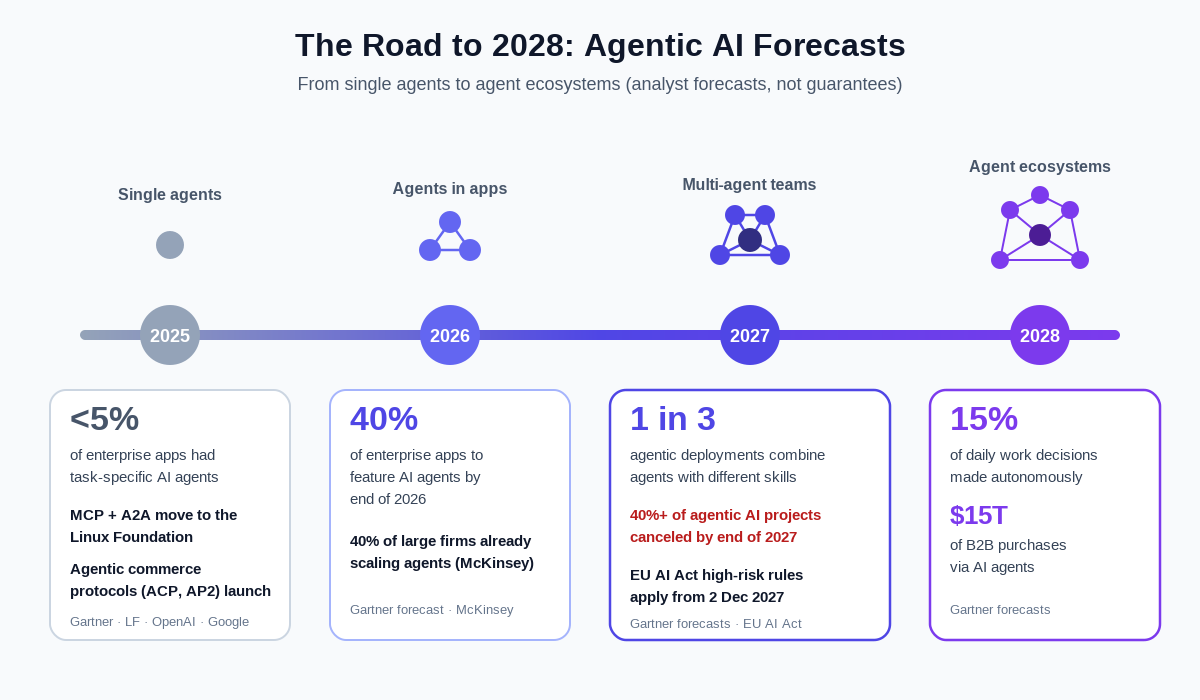
From single agents to agent ecosystems: key forecasts for 2025–2028.
Multi-agent ecosystems (forecast). Gartner predicts that by 2027, one-third of agentic AI implementations will combine agents with different skills to handle complex tasks. By 2028, it expects networks of specialized agents to collaborate across applications.
Agent-to-agent standards mature. With MCP and A2A now under Linux Foundation governance, expect more cross-vendor interoperability, so your agent can talk to a supplier's agent without custom code.
Agentic commerce goes mainstream (forecast). Protocols like OpenAI and Stripe's ACP and Google's Agent Payments Protocol (AP2) are laying the payment rails. Gartner forecasts AI agents will intermediate more than $15 trillion in B2B purchasing by 2028.
Regulation gets real. Under the EU AI Act's Digital Omnibus changes, obligations for stand-alone high-risk AI systems now apply from 2 December 2027, so agents used in areas like hiring, credit or essential services will need risk management, human oversight and documentation.
Human-in-the-loop by design. Expect "supervised autonomy": agents act freely on low-risk steps and pause for approval on high-stakes ones.
From copilots to outcomes (forecast). Gartner expects that by 2028 more than half of enterprises will stop paying for assistive AI and move to platforms that commit to workflow results. It also predicts at least 15% of day-to-day work decisions will be made autonomously by agentic AI by 2028.
Government adoption (forecast). Gartner predicts at least 80% of governments will deploy AI agents to automate routine decision-making by 2028.
Use agents first. Try an agentic coding tool or a browser agent on a real task to see how the loop behaves.
Learn the fundamentals. Get comfortable with prompting, function calling and how embeddings and vector databases work.
Build a tiny agent. Use the OpenAI Agents SDK, Claude Agent SDK or Google ADK to build an agent with one or two tools, such as web search plus a calculator.
Connect an MCP server. Hook your agent up to an existing MCP server (files, GitHub or a database) to see how standard tool access works.
Study failure. Log every step, try to break your agent with tricky inputs and read the OWASP agentic Top 10.
Pick one high-volume, low-risk workflow with clear success metrics, such as order-status questions or ticket triage.
Check that it really needs an agent. If fixed rules work, plain automation is cheaper. Gartner's advice is to use agents where decisions are needed.
Get your data and APIs ready. Agents are only as good as the systems they can reach.
Design guardrails first: least-privilege access, spending limits, human approval for risky actions, and full logging.
Pilot, measure, then scale. Track resolution rate, cost per task, error rate and customer satisfaction before expanding.
Plan for people. Train staff to supervise, correct and improve agents.
Agentic AI moves AI from a tool you talk to into a teammate that gets things done. The building blocks are mature: capable LLMs, standard protocols like MCP and A2A, and production-ready frameworks from OpenAI, Anthropic, Google and Microsoft. The early results in support, coding, healthcare, security and logistics are real.
So are the risks. The winners in 2027 won't be the companies with the most agents. They'll be the ones that pick the right problems, keep humans in the loop and treat security and governance as part of the design.
Over to you: Are you using AI agents at work or building one yourself? Share your experience in the comments, pass this guide to a colleague who's still confusing chatbots with agents, and subscribe for more practical guides on AI, SEO and web development.